

Tax deed investing still makes sense in 2026 for people who research before they bid. Tax liens can pay interest set by state law, and tax deeds can get you real estate for less than it’s worth. Just know going in that it takes up front research, and yes, you can lose money. Every investment has some level of risk, but risks can be significantly reduced by doing your due diligence before you buy. Never Bid Blind.™
My first property was a house in Kissimmee in 2006. 12 years later I started Tax Deed Genius, and today I teach tax liens and tax deeds in all 50 states. What follows is the talk I give every new student before they spend a dollar.
How tax deed and tax lien sales work
Property taxes pay for things like schools and roads. So when an owner falls behind, the county has to collect somehow. Lien states sell a tax lien certificate for the debt. You pay the owner’s tax bill, and the owner then owes you, plus interest. Deed states skip that step and auction the property. Florida runs both: tax lien certificate auctions annually, and tax deed sales monthly, depending on the county’s inventory. Some counties hold auctions multiple times per month.
Check out my FAQ page for each sale, and the States Cheatsheet to find which sale your state uses.
Why investors use tax deeds and tax liens
- The interest rate is set by law. In Florida, a tax lien certificate can pay up to 18% a year, and bidders bid that rate down at the sale. Every state sets its own rules.
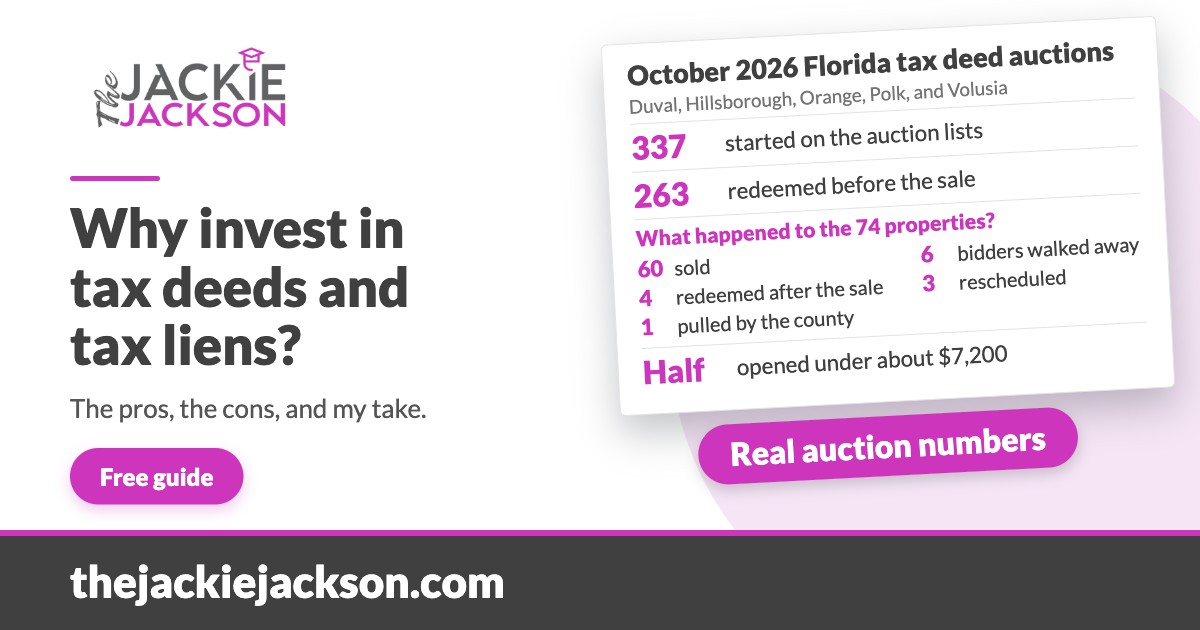
- With tax deeds, you can start smaller than with a regular purchase. When I went through 5 Florida tax deed auctions from October 2026 (Duval, Hillsborough, Orange, Polk, and Volusia), half of the 337 properties opened under about $7,200.
- The records are public. You can look up the title, the tax history, and the property before you bid, and it costs you nothing but time.
- It fits around a full-time job. Most Florida counties auction online now, so my students research at night and bid from home. I always say: Keep Your Career. Build Your Real Estate Portfolio.™
- Tax liens can turn into passive income once you know the process. After you buy a lien, you mostly wait for the owner to repay you. Tax deeds are a different story, and I’ll get to that.
The cons you shouldn’t skip
- Most properties never reach the auction because they are redeemed. Remember those same 5 auctions? 263 of the 337 properties were pulled because the owner paid the taxes first. That’s good news for lien holders. For deed buyers, it means the auction list gets smaller over time, but that doesn’t mean there are no opportunities to consider.
- Auctions may have competition. The 60 that sold went for anywhere from $2,000 to $415,000 depending on the property. Now don’t let these numbers discourage you, and here’s why. Say a property sold for 5 times its opening bid, at $35,000. That’s still an incredible deal, especially compared to the retail market value of the property.
- Title problems. A lot of title companies won’t insure a tax deed right away, so many tax deed buyers plan for a quiet title action or a title certification before they can sell.
- Liens that survive. Some code enforcement liens can stay with the property, and the IRS gets 120 days after the sale to redeem a property with a federal tax lien. This is why we research everything about the property, including liens, before we buy. That way, there are no surprises.
- Occupants and condition. Some properties may be vacant, while others may have someone still living there. Each state has a process in place to address getting the occupant out of the property. Check your state’s laws. Usually, you can’t go inside before you bid. However, you can always drive by or have someone take pictures for you.
- Pay attention to land deals. The good news is most vacant lands on tax deed auctions are vacant residential land that you may be able to build on (always check with the county first). Some parcels are cheap for a reason, like a strip of land you can’t build on.
- Fast deadlines. Each county has its own deadline rules, so you should always read the requirements so you are prepared when you win the bid. Most counties want the balance quickly after you win, so your money has to be ready before the sale.
So tax deed investing is active work. You research, bid, clear the title, and then sell or rent. If someone sells it to you as a passive income strategy from day one, be careful. All good things require some level of effort and work. The upfront work is not difficult, it’s just a process. And, that’s what I teach in Tax Deed Genius Real Estate Training Program.
Is tax deed investing worth it in 2026?
I think it is, for the right person. That’s someone who will do the research, set a maximum bid, and walk away when the numbers don’t work. Cheap doesn’t mean it’s a deal.
I learned that the expensive way. Investing on my own cost me $120,000 before I found a mentor and started researching first. Now I teach students to look for the reasons not to buy. Due diligence isn’t about proving you should buy. It’s about discovering why you shouldn’t.
How to get started
- Pick your goal first. Interest from liens, or property from deeds. Goal Before Geography.™
- Pick a state and read its rules. The Cheatsheet links to every state’s tax sale law.
- Practice on a real sale list. Pull your county’s list and research 5 properties before you ever bid. My FAQ shows where to find the list.
- Set your maximum bid with every cost in it: the bid, fees, title work, repairs, and holding costs.
- Learn the full process. Tax Deed Genius Lite is my 2-week beginner course for $197. Tax Deed Genius is the full 8-week course for $2,997. If you can’t decide, grab a free 30-minute strategy call with me.
Rules vary by state and county, so check the county’s current terms before you bid. This is general education, not legal advice.
Questions about tax deed investing
Is tax deed investing passive income?
Not at first. A tax lien gets pretty close once you own it, because your main job is waiting for the owner to repay you with the interest for your tax lien. A tax deed requires you to research the title, possession, repairs, and then decide whether to sell or rent your property out.
Can you start tax deed investing with little money?
Sometimes. In the October 2026 Florida auctions I reviewed, the lowest opening bid was about $1,000. Budget for title work and fees too, and have the money ready before the sale, because counties want payment fast.
What are the pros and cons of tax lien investing?
The pros are interest set by state law, a debt backed by real estate, and public records you can research for free. The cons are that rates may get bid down, your money is not available during the redemption period, and possible delays if the owner files for bankruptcy.
Is tax lien investing legit?
Yes. Counties sell tax liens and tax deeds under state law to collect unpaid property taxes. What isn’t legit is anyone who promises you a guaranteed return.






Leave A Comment
You must be logged in to post a comment.