

A surplus funds recovery business helps former owners claim the money left over after their property sells at a tax deed sale for more than the taxes owed. The county holds that money, and a lot of former owners never find out it’s there. You find them, explain what’s waiting, and help them file the claim.
I’ve invested in real estate since 2006, and I teach this work inside Tax Deed Genius. Here’s how it goes, one step at a time.
As of October 2026, approximately $4.6 million in surplus funds is waiting to be claimed in Duval County. That’s just 1 out of 3,144 counties in the United States.
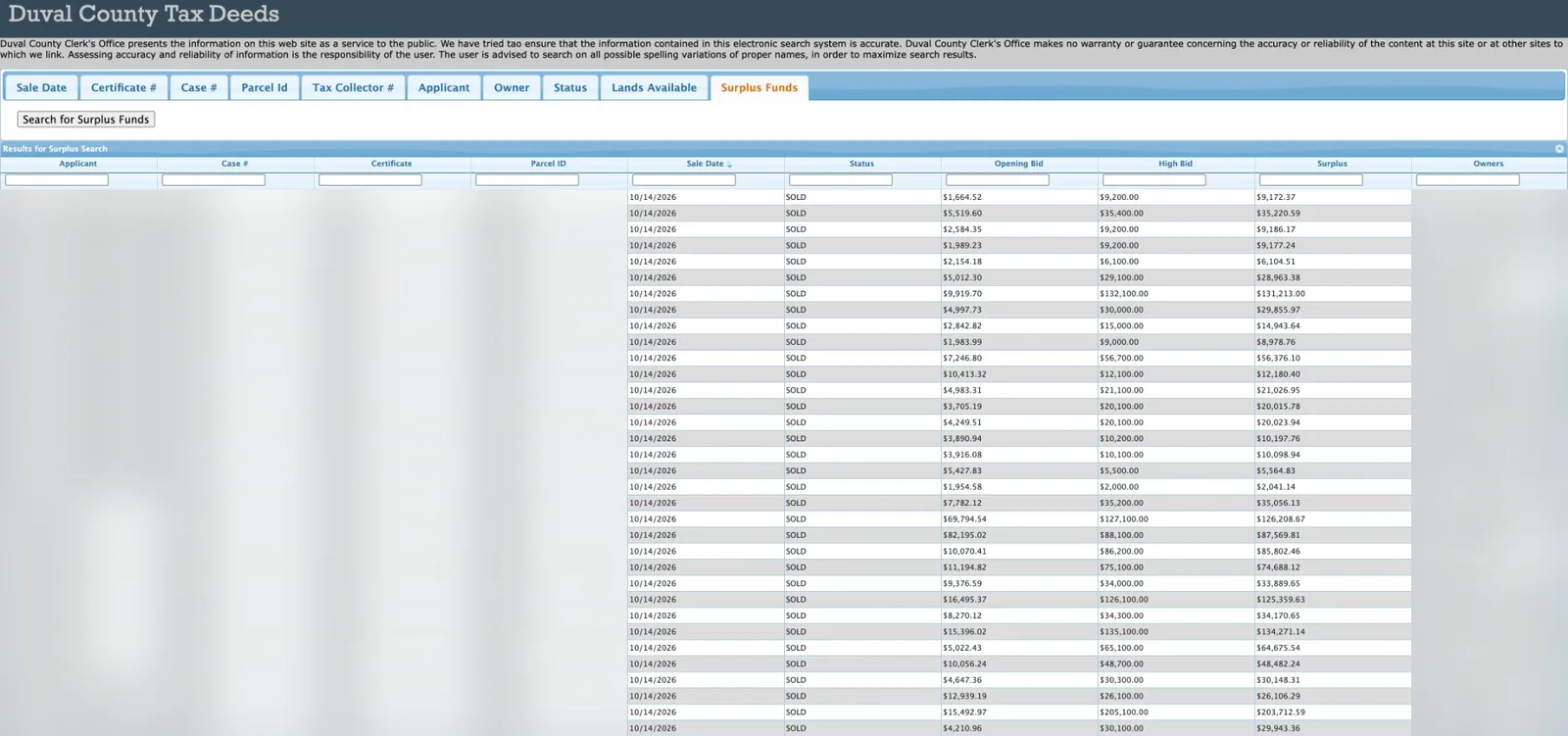
Part of the real surplus list from the Duval County, Florida, tax deed sale on October 14, 2026. Tap the image to see the full list, with names, case numbers and parcel numbers blurred.
What a surplus funds recovery business does
When a property sells at a tax deed auction, the county keeps what’s owed in back taxes and costs. If the winning bid is higher, the extra is the surplus. You’ll also hear it called overages, excess proceeds, or overbids. Same money, different names.
Look at the Duval list above. One property sold for $132,100, and the list shows $131,213 in surplus funds. That money sits with the clerk until the right person claims it.
Who the money belongs to
The surplus doesn’t belong to the county, and it doesn’t belong to you. It belongs to the former owner, and sometimes to lienholders, like a mortgage company that still had a loan on the property.
So your job is to help the rightful person get paid. That means you tell them the truth about what you do and what you charge, in writing, before they sign anything.
How a claim works, step by step
- Find the surplus list. A lot of county clerks post one online, like the Duval list above.
- Research who has a claim. Pull the deed and check for liens, so you know who’s first in line for the money.
- Find the former owner. Skip tracing helps here. Lead with respect, because this person just lost a property.
- Prepare the paperwork. I use a surplus notice, an agent agreement, a limited power of attorney, a county affidavit of surplus, and a cover letter.
- File with the clerk and follow up until the claim is paid.
Check your state’s rules before you start
Every state handles surplus a little differently. In Florida, the clerk mails a notice of surplus to everyone with an interest in the property, and claims are filed in writing with the clerk within 120 days of that notice. A lienholder who misses the 120 days loses the right to the money. The former owner doesn’t (Florida Statutes, section 197.582).
That Florida law doesn’t say anything about agents or what an agent may charge. Rules on who can file and on agent fees vary from state to state. So read your state’s current law, and the county’s own process, before you contact anyone.
How to learn it the right way
I teach this in the Surplus Overages Course. It’s the surplus module from my 8-week Tax Deed Genius program, sold on its own: 15 lessons, online and open 24/7, with the documents I use and my 13-step Overage Surplus Checklist. Most students finish in 1 to 2 weeks.
If you want me to walk you through it, one county and one claim at a time, start with my tax overages training.
Lessons in the Surplus Overages Course
- What are Surplus Overages, Over Bids & Excess Funds?
- Surplus Notice to former property owner
- Surplus Agent Agreement
- Limited Power of Attorney (Attorney in Fact)
- IRS Form W-9
- Sample Cover Letter
- County Affidavit of Surplus
- Evidence to prove ownership interest
- IRS 1099
- How to communicate with the former owner
- Let’s Role Play video
- Mobile & Virtual Notary Services
- Skip Tracing Services
- What states allow surplus overage recovery (Bonus)
- Overage Surplus Checklist (Bonus)
Still picking a state? My Tax Lien & Tax Deed States Cheatsheet shows how each state sells, and the Tax Lien Due Diligence Checklist keeps your research in order.
Questions people ask
Is a surplus funds recovery business the same as tax overages?
Yes. Surplus funds, tax overages, excess proceeds and overbids all mean the money left over after a tax sale.
Who can file a surplus claim?
People with an interest in the property, usually the former owner and any lienholders. You can help them, but the claim is theirs.
Do I need a license to help with surplus claims?
It depends on your state. Some states set rules on who can help a claimant and what they can charge, so check your state’s law first.
How long does the Surplus Overages Course take?
It has 15 lessons, and most students finish in 1 to 2 weeks. There’s a short quiz at the end, and you need 90% to pass.
Someone will make that call to the former owner
New surplus lists go up after every tax deed sale, and the former owners on them are waiting for someone to explain what they’re owed. Every month you wait, other people learn the process and make those calls first. When you start the Surplus Overages Course, you’ll know how to read a county list, reach the former owner the right way, and file a clean claim with the clerk.
The Surplus Overages Course is $1,497.